Grading is the least glamorous part of a landscape and the part that determines whether everything else survives. It’s the shape of the ground — where it’s high, where it’s low, and which direction water travels when it lands. On Denver’s expansive clay soils, that shape is doing structural work.
The direct answer to the question most people are asking: your yard should slope continuously away from the house, roughly six inches of fall within the first ten feet from the foundation, then a sustained grade of about 2% across lawn and planting areas toward a legal discharge point. If water pools anywhere for more than about 24 hours, or if any part of your yard slopes back toward the structure, you have a grading problem worth correcting.
Here’s how to tell what you’re dealing with, what a proper correction actually involves, and when this crosses from a weekend project into professional territory. Thunderbird Design builds landscapes across the Denver metro, and grading is the first thing we measure on every site — before layout, before plant selection, before anything.
What “Proper Grading” Means in Measurable Terms
Grading is expressed as slope: vertical drop divided by horizontal distance. A handful of benchmarks cover almost every residential situation.
The first ten feet from the foundation should fall at roughly 5%, which works out to about six inches of drop. This is the single most important zone on the property, and it’s the one most often wrong on established homes.
Lawn and planting areas need about 2% at minimum — roughly a quarter inch of drop per foot. It’s a gentle grade, but it’s enough to keep water moving across the surface instead of collecting.
Swales and drainage channels need 1% as an absolute floor and 2% is better, which is about an inch of drop every four to eight feet. Below 1%, sediment settles out and the channel gradually stops working.
Patios, walks, and other hardscape should shed at 1% to 2% — enough to move water off the surface without feeling tilted underfoot.
Mowable turf tops out around 25%, or a 4:1 slope. Anything steeper than that needs terracing, a retaining wall, or ground cover instead of grass.
Two things people find counterintuitive. First, 2% is nearly imperceptible — you cannot see it, which is exactly why grading gets ignored and why it has to be measured with an instrument rather than judged by eye. Second, more slope isn’t automatically better. Steep grades erode, shed water too fast for plants to use, and are miserable to maintain.
Why Grading Matters More in Denver Than Most Places
Three regional realities raise the stakes.
Expansive soils. Front Range clay swells when wet and shrinks when dry, and that volume change generates real force. Colorado is a heave state as much as a settlement state — foundations, slabs, and flatwork here move upward when adjacent soil takes on water. Grading is your primary control on soil moisture near the structure, which makes it a foundation-protection measure and not just a landscaping detail.
Construction backfill settlement. The soil placed back against a foundation after excavation is disturbed, and it consolidates for years afterward. Builders typically grade correctly at closing, then the backfill zone settles and the slope quietly reverses. This is why so many Denver homes have negative grade at the house at year eight despite having passed inspection at year zero. It’s not a defect; it’s physics, and it needs periodic correction.
Frozen ground and snowmelt. In spring, frozen or saturated ground behaves like an impermeable surface. Meltwater doesn’t infiltrate at all — it runs entirely on the surface, in volume, toward whatever the low point happens to be. If that low point is your window well, the grade is the only thing that was ever going to protect you.
Seven Signs of Poor Grading
Ignoring these is one of the more expensive landscaping mistakes Colorado homeowners make, largely because the evidence accumulates slowly.
Walk your property during or just after a real storm — that’s when the diagnosis is easy. Otherwise, look for the evidence water leaves behind.
1. Standing water that lasts more than a day
Puddles are normal during a downpour. Puddles 24 to 48 hours later mean water has nowhere to go. Note the locations; they’re your map.
2. Soil, mulch, or beds higher than the surrounding grade at the house
Look at where soil meets siding or stucco. Beds get top-dressed with mulch annually, gain an inch or two a year, and eventually form a dam that holds water against the foundation. You want to see the concrete foundation wall and slope falling away, not a berm.
3. Water stains, efflorescence, or a horizontal moisture line in the basement
The white, chalky mineral bloom on interior foundation walls is dissolved salts left behind by water moving through concrete. It’s a reliable indicator of exterior moisture pressure, and it points at grading and downspouts long before it points at anything else.
4. Erosion channels, exposed roots, or mulch consistently washed out of one bed
Water always takes the same path. Visible rills, silt fans on hardscape, and mulch relocated to the same corner every year are a flow map you can read without a rain gauge.
5. Settled, tilted, or cracked hardscape
Patios that dip toward the house, pavers with an obvious low spot, walkway slabs offset at joints, or a driveway with a new pond in it. Moisture changes under hardscape drive movement, and on expansive clay it can go either direction.
6. Persistently soggy or dead patches with no other explanation
Turf that’s chronically wet and thin in the same spot, or moss in a semi-arid climate, means water is collecting there. So does the reverse: a dry ridge where water sheds off too fast for anything to establish.
7. Ice sheets in the same place every winter
A recurring ice patch at a door, on a walk, or across a driveway apron is a low spot advertising itself. It’s also a liability issue and one of the most common reasons homeowners finally call about grading.
Two Simple Tests You Can Do Yourself
The puddle test. After rain or a long irrigation cycle, photograph every spot holding water and check again 24 hours later. Anything still wet goes on the list. Do this three or four times across a season and the pattern becomes unmistakable.
The string test. Drive a stake at the foundation and another ten feet out. Run a string between them and level it with a line level at the foundation stake. Measure from the string down to the ground at the far stake. That measurement is your drop across ten feet — you want roughly six inches. If it’s two inches, you have insufficient fall. If the ground is above the level string, you have negative grade and water is running toward your house.
That second test takes fifteen minutes and tells you more than most inspections. It’s also the point where a lot of homeowners realize the problem is real.
How Professional Regrading Actually Works
The common misconception is that grading means dumping topsoil in the low spots. That works for about one season, because loose fill settles and the low spot returns.
Proper regrading sequence:
- Survey and design. Shoot existing elevations with a laser or rotary level, identify the discharge point, and design the flow path. You cannot correct a grade without first establishing where the water is supposed to end up — that’s the constraint everything else works backward from.
- Strip and stockpile topsoil. Set aside the good soil rather than burying it.
- Shape the subgrade. Cut and fill the underlying material to the design contour. This is where the slope is actually created.
- Compact in lifts. Fill placed in thin layers and compacted holds its shape. Fill dumped in a single pile does not, which is the difference between a fix and a recurring problem.
- Respread topsoil to finished grade, maintaining the design slope in the finished surface.
- Verify. Re-shoot the grade and confirm continuous positive fall with no birdbaths along the flow path.
- Restore the surface with sod, seed, planting beds, or mulch, and protect against erosion until it establishes. On new construction or a full rebuild, this step folds into the broader landscape installation sequence.
Depending on the site this may also involve integrating swales, catch basins, downspout carriers, or a French drain. On Denver’s tight clay, grading and conveyance usually get designed together — we cover why in our guide to drainage solutions for Denver clay soil.
When Grading Alone Isn’t Enough
Regrading solves a large share of residential drainage problems, but not all. You’ll likely need additional measures when:
- There’s no viable discharge point. Flat lots, or yards fully enclosed by higher neighboring property, may need a piped system and possibly a pump.
- Water is coming from uphill. If a neighbor’s yard, an alley, or a street is delivering flow onto your property, you need interception — a swale, curtain drain, or berm — before you worry about your own contours.
- The problem is subsurface. Persistently saturated soil with no surface source, or seepage on a slope, points to groundwater and generally calls for a French drain or curtain drain.
- Available fall is minimal. Some lots simply don’t have enough elevation change to move water by gravity across the required distance.
- Existing improvements are in the way. A patio, wall, mature tree, or shed sitting on the drainage path constrains options and forces a design conversation rather than a dirt-moving one.
- The structure is already showing distress. Active foundation cracking, doors and windows out of square, or floor slope changes warrant a structural engineer, not a landscaper. Grading is part of the remedy, but it isn’t the diagnosis.
Legal and Neighbor Considerations in Denver
This is the part homeowners most often overlook, and it causes genuine conflict.
You generally cannot materially increase concentrated water flow onto adjoining property. Colorado drainage law protects neighboring landowners from having runoff meaningfully redirected or concentrated onto them. Solving your puddle by pushing water into your neighbor’s yard isn’t a solution; it’s a liability, and it’s one of the more common ways drainage projects end up in a dispute.
Discharge into the public right-of-way is regulated. Denver and surrounding municipalities have rules about how and where private drainage can enter streets, alleys, gutters, and storm systems. Check before you build the outlet.
Grading can trigger permits. Larger earth-moving projects, work in a floodplain, work that alters an established drainage pattern, and retaining walls above a certain height — often around four feet in Denver-area jurisdictions — typically require permitting and sometimes engineered design. Verify with your local building department.
HOA and covenant review. Many metro subdivisions have designated drainage easements and swales that cannot be altered, filled, or built over. Filling a subdivision swale to gain lawn space is a reliable way to flood two houses.
Call 811 first. Colorado law requires notifying Colorado 811 before excavation, generally at least two business days ahead. Non-negotiable, and free.
DIY Versus Hiring a Professional
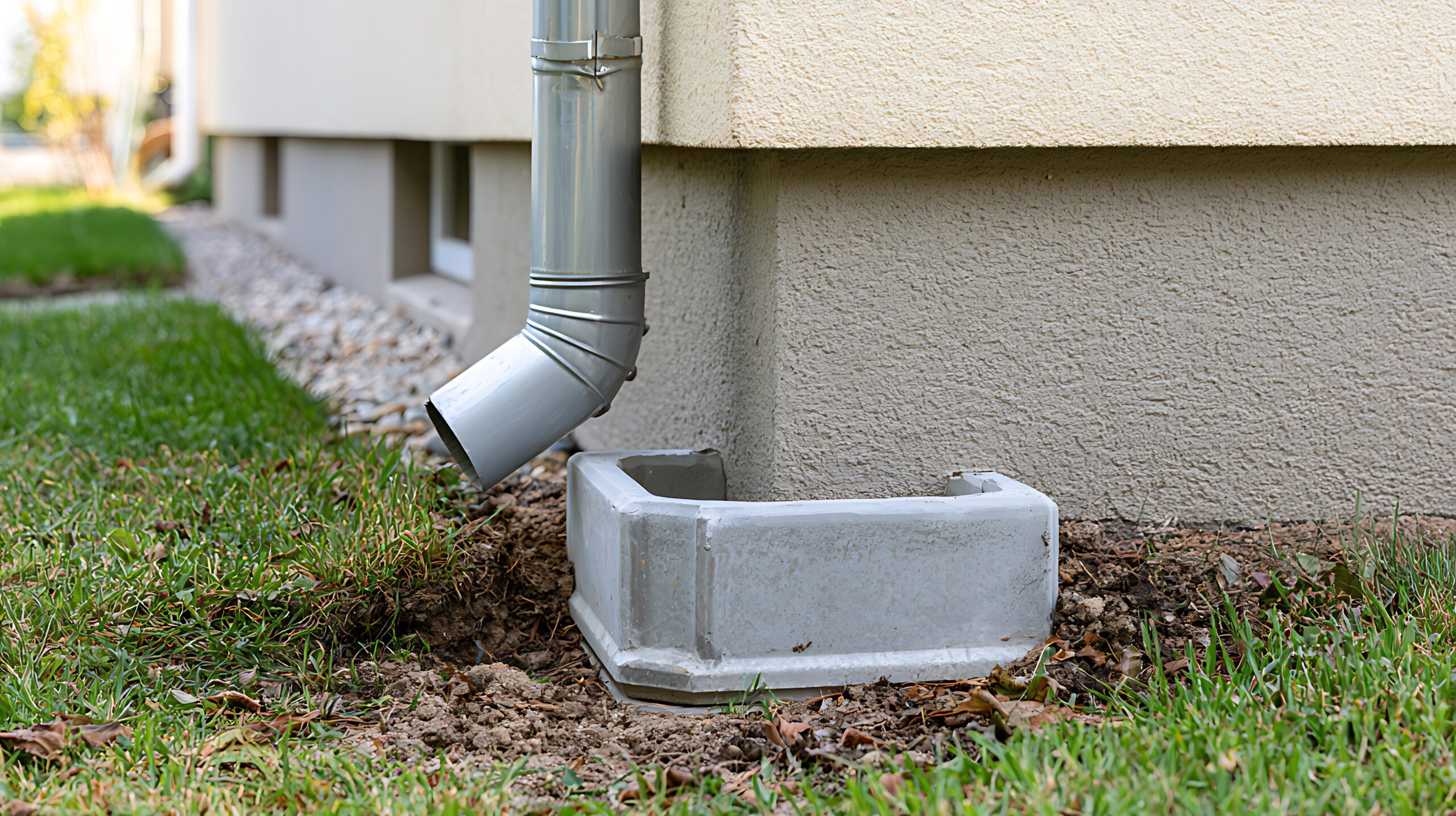
Plenty of this work is genuinely homeowner-friendly. Diagnosis in particular is worth doing yourself — the puddle test, the string test, and photographing where water flows during a real storm cost nothing and give any contractor you eventually call a much better starting point. Downspout extensions, splash blocks, and above-grade routing are straightforward. So are small corrections: pulling back mulch that has built up above grade, re-sloping a single bed, filling a minor birdbath in the lawn.
The work worth handing off falls into a few categories:
- Elevation survey and diagnosis of subsurface water. Finding out where the water is actually coming from, and shooting existing grades to establish what the yard is doing now.
- Whole-yard regrading. This needs instruments, equipment, and proper soil handling — stripping topsoil, shaping subgrade, compacting in lifts.
- Swales, buried downspout carriers, pop-up emitters, and drain networks. Slope tolerances are tight and mistakes get buried where you can’t see them.
- Anything within the foundation zone. The consequences of getting this wrong are structural rather than cosmetic.
- Restoration beyond seed and mulch. Sod, planting design, and hardscape reconstruction after the earthwork is finished.
The honest dividing line: if you’re moving soil within a couple feet of your foundation or trying to establish slope you can’t see, get instruments on it. Grading errors are invisible until the wrong thing gets wet, and they’re buried under finished landscape by the time they show up.
What Grading Work Costs in Denver
Nobody can quote this accurately without seeing the site, and any contractor who does is guessing. The real cost drivers:
- Volume of soil to be moved, imported, or hauled off
- Equipment access — a gated backyard with a four-foot opening changes the entire approach and the labor hours
- Restoration scope — sod, planting, irrigation repair, and hardscape rebuilding often exceed the earthwork itself
- Whether drainage structures are included — pipe, basins, and outlets add materially
- Soil and rock conditions — claystone shows up shallow in parts of the metro
- Permitting and engineering, when triggered
Minor corrections and downspout routing sit at the low end. Comprehensive regrading with a piped system and full landscape restoration is a substantial project. What’s consistent is the comparison: grading work is materially cheaper than foundation repair, and the whole point of doing it is not needing the latter.
Frequently Asked Questions
How much should a yard slope away from the house?
About six inches of fall within the first ten feet from the foundation — roughly a 5% slope — then approximately 2% across the remainder of lawn and planting areas toward a legal discharge point.
What are the signs of poor yard grading?
Standing water lasting more than 24 hours, soil or mulch built up above the foundation grade, efflorescence or moisture lines in the basement, erosion channels and washed-out mulch, settled or tilted hardscape, chronically soggy turf, and recurring ice patches in the same location each winter.
Can I regrade my yard myself?
Small corrections — removing built-up mulch, re-sloping a bed, extending downspouts — are reasonable DIY projects. Whole-yard regrading and any work in the foundation zone should be professional, because it requires measured slope, proper compaction in lifts, and knowledge of where water can legally discharge.
Why does my yard slope toward my house when the builder graded it correctly?
Because the disturbed soil backfilled against the foundation during construction continues consolidating for years. The original grade was likely correct at closing; settlement gradually reversed it. This is common on Denver-area homes and is a maintenance item, not necessarily a construction defect.
How much does yard grading cost in Denver?
It depends primarily on soil volume, equipment access, and restoration scope rather than square footage alone. Small corrections are inexpensive; comprehensive regrading with drainage structures and landscape restoration is a significant investment. An on-site assessment is the only way to get a real number.
Do I need a permit to regrade my yard in Denver?
Sometimes. Larger earthwork, work that alters established drainage patterns, floodplain work, and retaining walls above a certain height commonly require permits or engineered design. Confirm with your municipality, and always call Colorado 811 before digging.
Can I direct water onto my neighbor’s property?
No. Colorado law generally prohibits materially increasing concentrated flow onto adjoining land. Drainage has to be resolved on your own property or through a legal discharge point.
Is fall a good time to regrade a yard in Denver?
Yes, and it’s one of the better windows. Plants are dormant, soil is workable before the freeze, and completing work in fall means spring snowmelt has a designed path. We often schedule it alongside fall maintenance work.
Get the Ground Right First
Grading is the layer everything else rests on. Sod, plantings, patios, and irrigation all perform better on correctly shaped ground, and all of them are expensive to redo when the ground beneath them was wrong from the start. It’s also the part of a landscape that quietly protects the most valuable thing on the property.
If you’re seeing any of the signs above — or you ran the string test and didn’t like the answer — schedule a site visit. We’ll shoot elevations, tell you where your water is actually going, and give you a straight assessment of whether you need a modest correction or a real project. Either way, you’ll know.