If you’ve watched a puddle sit in the same spot in your Denver yard for two days after a fifteen-minute storm, you already understand the problem. The water isn’t going down because, in most of the Denver metro, it can’t. Our soils are clay-dominated, tight, and slow, and a lot of drainage advice written for sandy or loamy ground simply doesn’t apply here.
The direct answer: effective drainage on Denver clay soil works by moving water across the surface and out, not by trying to soak it in. That single distinction — conveyance rather than infiltration — is what separates the solutions that hold up here from the ones that fail in the second season.
We’ve built and repaired enough of both across the Front Range that we can be specific about which is which. Thunderbird Design approaches drainage as a design problem first, because the fixes that work are the ones you can live with looking at.
Why Denver Clay Soil Drains So Poorly
Three factors compound in the metro area.
Particle size. Clay particles are microscopic and plate-shaped. They pack together with very little pore space, so water percolates in fractions of an inch per hour rather than inches. Much of the metro sits over the Denver Formation, with claystone and clay-rich soils near the surface, so this isn’t a topsoil problem you can amend your way out of.
Expansiveness. Front Range clays are expansive — they swell measurably when they absorb water and shrink when they dry. That volume change is a structural force. It’s why Colorado foundations are more likely to heave than to simply settle, and why sidewalks, patios, and driveways here tilt in patterns that surprise people from other states. Keeping water away from soil adjacent to structures isn’t fussiness; it’s the whole ballgame.
Precipitation pattern. Denver is semi-arid, with roughly 14 to 15 inches of annual precipitation, but a meaningful share of it arrives in short, intense summer thunderstorms. Low total rainfall lulls people into ignoring drainage, then a single high-intensity cell delivers more water in twenty minutes than the soil can accept in a day. Add spring snowmelt over still-frozen ground — which behaves like pavement — and you get the two events that cause almost all the damage we’re called out to inspect.
The Solution That Usually Fails Here: Dry Wells
Worth addressing directly, because it gets recommended constantly.
A dry well is a buried gravel-filled pit or chamber meant to hold runoff and let it infiltrate. In sandy soil, it’s elegant. In tight Denver clay, it’s often a bathtub with no drain: water fills the void, has nowhere to percolate, sits there, and either backs up to the surface during the next storm or slowly saturates the clay around your foundation — which is exactly the outcome you were trying to prevent.
The same logic applies to poorly considered “sump and pit” solutions and to rain gardens sized using national infiltration assumptions. Rain gardens can work in Denver, but only when they’re excavated deep, backfilled with an engineered soil profile, and given a positive overflow outlet. Without the overflow, you’ve built a mosquito nursery.
Before installing any infiltration-based solution, dig a test hole, fill it with water, and measure how fast the level drops over several hours. If it barely moves, design for conveyance instead.
Grading: The First and Most Important Fix
Every drainage conversation should start here, because grading is what makes everything else optional.
Water needs continuous positive fall from your structure to a legal discharge point. The residential benchmark most builders and inspectors work from is roughly six inches of drop within the first ten feet from the foundation, then a sustained slope across the rest of the yard — commonly around 2% for lawn and planting areas, and at least 1% across hardscape.
Common grading failures on established Denver properties:
- Beds that have been top-dressed with mulch every spring for fifteen years until they’re higher than the adjacent lawn, trapping water against the house
- Sod laid over the original construction backfill after it settled, without re-establishing the slope
- New patios, sheds, or raised beds placed across the natural drainage path, damming water uphill of the improvement
- Fences with solid bottom rails and no gap, which act as small dams during heavy flow
- A neighbor’s regrading or new addition changing where water arrives on your property
Regrading isn’t just adding soil. Done properly it means stripping and stockpiling topsoil, reshaping and compacting the subgrade to the design slope, then respreading topsoil so the finished surface holds its shape instead of settling back into a low spot. Because slope is measured, not eyeballed, this is the piece of drainage work most worth having shot with a laser level. If you want to understand what your yard should look like before you call anyone, we’ve written a homeowner’s guide to yard grading and slope correction.
French Drains: Effective When Built Correctly
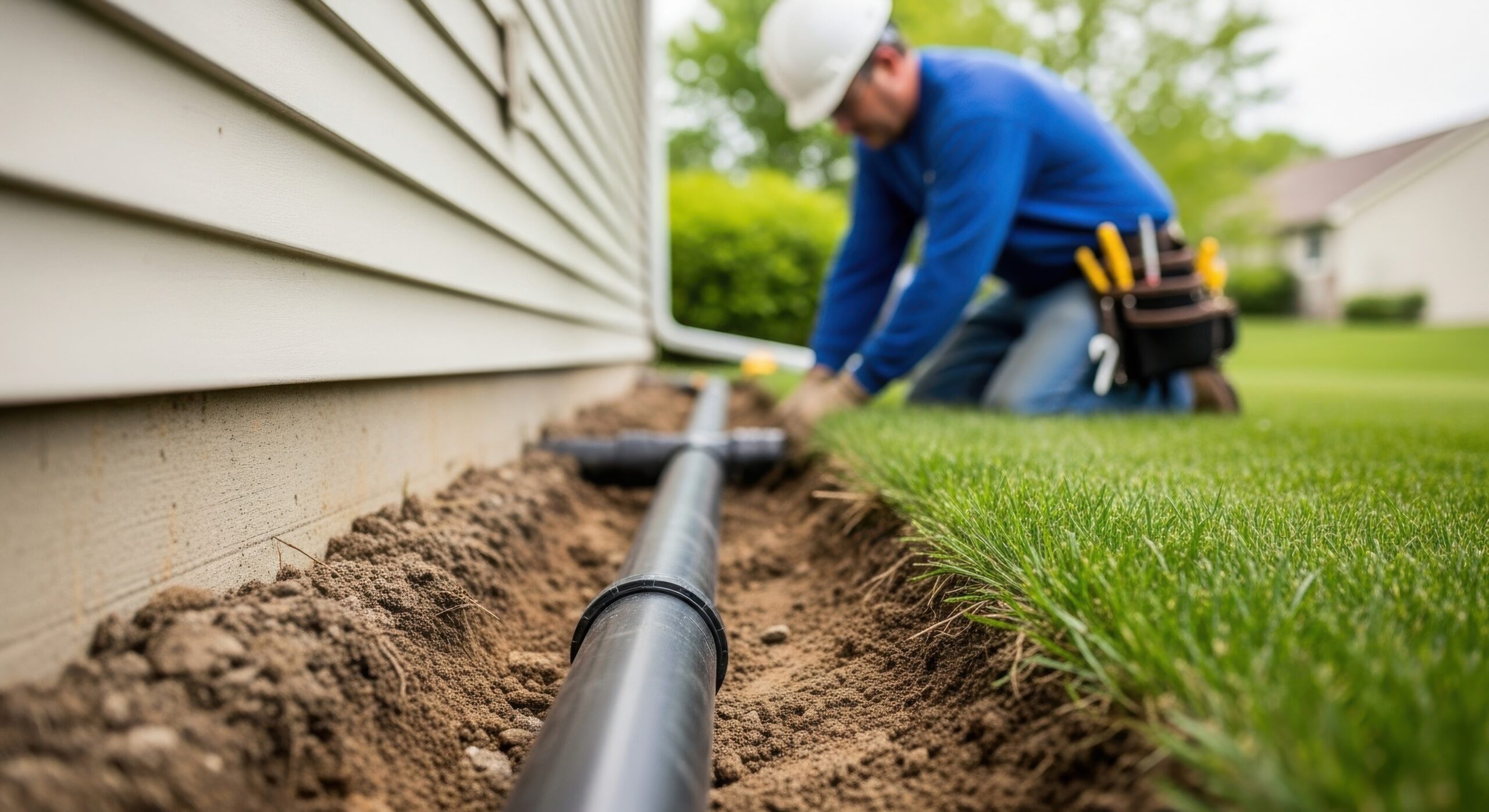
A French drain is a gravel-filled trench with perforated pipe that intercepts subsurface and surface water and carries it somewhere else. In clay, it functions as a collection and conveyance system — it is not soaking water into the surrounding soil.
What separates a French drain that works for twenty years from one that clogs in three:
- Slope. The pipe must fall continuously toward the outlet — commonly a minimum of about 1% (roughly an inch of drop every eight feet). Flat pipe holds sediment and stops working.
- Washed angular gravel. Clean, angular ¾-inch rock maintains void space. Pea gravel and unwashed material pack tight and defeat the purpose.
- Geotextile fabric wrapping the gravel envelope. In clay, fine particles migrate into the void space and blind the drain. Filter fabric on the outside of the gravel — not just a thin sock on the pipe — is what buys longevity.
- Rigid perforated pipe over corrugated flex. Flex pipe is cheap and easy to install with sags in it, and sags are where sediment collects.
- A real outlet. Daylighting to a lower point, a pop-up emitter, or a permitted connection. A French drain that dead-ends underground is a dry well with extra steps.
- Cleanouts. Access at the upstream end so the line can be jetted rather than excavated.
Two Denver-specific notes: keep the trench and pipe far enough from mature tree root zones that you don’t sever structural roots, and remember that Colorado 811 locates are required by law before you dig — generally with at least two business days’ notice. That’s not a formality; utility depths in older Denver neighborhoods are frequently not where you’d assume.
Dry Creek Beds: Conveyance That Doubles as Design
A dry creek bed is a lined, rock-armored surface channel that carries stormwater. On clay soil it’s one of the most appropriate solutions available, because it works with our reality — it moves water on the surface, at volume, without depending on infiltration.
It’s also the option that most often improves a yard aesthetically. A well-built dry creek reads as a natural feature year-round, gives a xeric planting scheme structure, and looks intentional in February when everything else is dormant. Poorly built ones look like someone dumped river rock in a ditch.
The difference comes down to construction and composition:
- Excavate a defined channel with consistent fall and shape it to look like water carved it — meandering, varying width, occasional pooling areas
- Line it with geotextile fabric to prevent soil migration and weed growth through the rock
- Use mixed rock sizes: larger anchor boulders, cobble in the channel bed, smaller gravel filling between. Uniform rock size is the single biggest visual tell of an amateur installation
- Set boulders partially buried, not perched on the surface
- Plant the banks with drought-tolerant grasses and shrubs that tolerate occasional inundation but don’t need it
- Size the channel for a real storm event, not an average one
Dry creek beds pair naturally with water-wise planting design, which is a good fit for Denver anyway given ongoing pressure on outdoor water use. If you’re rethinking the planting scheme around a new channel, these low-water landscaping ideas for Denver homes are a useful starting point.
Downspout Routing: The Cheapest High-Impact Fix
A typical Denver roof sheds a substantial volume of water in a single storm, and most of it exits through a handful of downspouts. If those discharge at the foundation, you are concentrating hundreds of gallons directly into expansive clay against your structure — the worst possible place for it.
Options, roughly in order of cost:
- Extensions and splash blocks — carry discharge six to ten feet out onto positive slope. Crude but effective, and dramatically better than nothing.
- Buried solid pipe to a pop-up emitter — smooth-wall (not corrugated) solid pipe running to a spring-loaded emitter that opens under flow and sits flush the rest of the time. Clean-looking and mow-over friendly.
- Buried pipe daylighting to a dry creek bed or swale — routes roof water into your primary conveyance system. This is usually the right answer when you’re doing comprehensive work.
Two rules: use solid pipe, not perforated, for downspout carriers — perforated pipe discharges water back into the soil along its length, which is the opposite of the goal. And don’t discharge onto a neighboring property. Colorado law generally doesn’t allow you to materially increase the concentrated flow of water onto adjoining land, and Denver has requirements about discharge into the public right-of-way. This is a real source of neighbor disputes.
While we’re on collected roof water: Colorado’s rain barrel statute permits residential rooftop collection, but only in limited volumes — up to two barrels with a combined capacity of 110 gallons at eligible single-family and small multi-family homes. Barrels are a nice supplemental irrigation source. They are not a drainage strategy.
Swales and Berms
A swale is a shallow, broad, vegetated channel — essentially engineered low ground that moves water where you want it. A berm is the raised counterpart that redirects flow. Together they’re the least intrusive way to manage sheet flow across a yard, because a well-shaped grass swale is invisible; most people walk across them without noticing.
Swales work well on clay for the same reason dry creeks do: surface conveyance. Keep them at a consistent minimum fall (roughly 1% at the absolute least, 2% preferred for turf), keep them free of debris, and don’t let landscape improvements interrupt them later. A swale that gets filled in for a new patio is a very common origin story for a flooded basement.
Protecting Hardscape from Clay Movement
Drainage failures show up in hardscape before they show up anywhere else, because patios and walls are rigid and clay is not.
Base preparation is everything. On expansive clay, patio and paver installations need a properly compacted aggregate base of adequate depth, built in lifts, often over geotextile separation fabric to keep clay from pumping up into the base course. Undersized base on clay is why so many Denver patios develop that characteristic dip near the house within a few years.
Retaining walls need drainage built in. A wall holding back clay is holding back water, and saturated clay exerts enormous hydrostatic and swelling pressure. That means free-draining aggregate behind the wall, filter fabric, and a perforated drain pipe at the base of the backfill with a functioning outlet. Walls fail from water pressure far more often than from load.
Permits matter. Retaining walls above a certain height — generally around four feet in many Denver-area jurisdictions — typically require permitting and engineered design. Verify with your local building department, because a non-compliant wall becomes a disclosure problem when you sell.
Keep the perimeter draining. Positive slope away from patio edges, no planting beds built up against the slab, and joints maintained so surface water sheds rather than infiltrating and freezing. This is why our patio and retaining wall construction always starts with a drainage plan rather than a layout.
Should You Amend Clay Soil Instead?
Amendment helps planting beds. It does not solve drainage.
If you’re improving beds:
- Compost is the standard amendment, worked into the top several inches. It improves structure, biology, and water-holding.
- Expanded shale is genuinely useful on Front Range clay and under-used by homeowners. The porous ceramic particles create durable pore space that compost eventually decomposes out of. CSU Extension has long recommended it for our soils.
- Never add sand to clay. The combination fills clay’s few pores with fine particles and produces something closer to concrete. This is the most persistent bad advice in home gardening.
Realistic expectation: amendment turns a difficult planting bed into a good one. It will not make a low spot drain. Those are different problems with different fixes.
Comparing Denver Drainage Solutions
| Solution | Best for | Clay soil suitability | Visible? | Relative cost |
| Regrading / slope correction | Water pooling near the foundation, broad low areas | Excellent — the foundation of every other fix | No, when done right | Moderate to high |
| Downspout extensions | Roof water at the foundation | Excellent | Yes | Very low |
| Buried downspout to pop-up emitter | Roof water, tidy result | Excellent | Barely | Low to moderate |
| Grass swale | Sheet flow across a yard | Excellent | Nearly invisible | Low to moderate |
| Dry creek bed | Significant surface volume, sloped yards | Excellent | Yes — by design | Moderate |
| French drain | Persistent saturation, subsurface water, hard-to-grade areas | Good, if built with fabric and real slope | No | Moderate to high |
| Catch basin + solid pipe network | Defined low points, patios, courtyards | Good | Grates only | Moderate to high |
| Dry well | Not much, here | Poor | No | Low to moderate |
| Rain garden | Aesthetic capture of modest volume | Conditional — needs engineered soil and overflow | Yes | Moderate |
| Soil amendment | Plant health in beds | Good for planting, not for drainage | No | Low |
Frequently Asked Questions
Why does water sit in my Denver yard for days?
Because clay-dominated soil percolates very slowly — often fractions of an inch per hour. Water that can’t infiltrate has to be moved across the surface, so standing water for more than about 24 hours usually indicates a grading or conveyance problem rather than a soil problem.
Do French drains work in clay soil?
Yes, when they’re designed as collection and conveyance systems rather than infiltration systems. They need continuous slope to a real outlet, washed angular gravel, and geotextile fabric around the gravel envelope to keep fine clay particles from clogging the void space.
Are dry wells a good option in Denver?
Usually not. Dry wells rely on water soaking into surrounding soil, which tight Denver clay does poorly. They frequently fill, stop functioning, and can saturate soil near the foundation. Test your infiltration rate before considering one.
What’s the best drainage fix for a Denver backyard?
Start with grading. Correcting slope and routing downspouts away from the house resolves a large share of residential drainage problems on its own, and every other solution depends on having somewhere for water to go.
Can I just add sand to improve my clay soil?
No. Mixing sand into clay produces a dense, concrete-like material. Use compost and expanded shale to improve structure in planting beds, and handle drainage as a separate grading and conveyance question.
Where can drainage water legally discharge in Denver?
To a suitable point on your own property or, in some cases, the public right-of-way subject to local requirements. Colorado law generally prohibits materially increasing concentrated flow onto a neighbor’s property. Confirm requirements with your municipality before building a discharge point.
How much does yard drainage work cost in Denver?
It varies widely with scope, access, soil conditions, and how much hardscape or planting has to be removed and restored. Downspout extensions are inexpensive; comprehensive regrading with a piped drainage network is a significant project. Get an on-site assessment rather than a phone quote — drainage priced sight-unseen is usually priced wrong.
Is fall a good time for drainage work in Denver?
Yes. Plants are dormant, soil is still workable before the freeze, and finishing before winter means spring snowmelt has somewhere to go. It’s a common time for us to schedule corrections alongside seasonal cleanup work.
The Takeaway
Drainage on Denver clay soil isn’t complicated once you accept the constraint: this soil will not absorb your problem for you. Grade it, convey it, discharge it legally. Solutions that respect that hold up. Solutions that assume infiltration don’t.
The other thing worth saying is that drainage doesn’t have to be an eyesore or an afterthought. A properly shaped swale disappears into a lawn. A well-built dry creek bed becomes the feature people compliment. Wall and patio drainage is invisible by definition. When drainage is planned into a full landscape installation from the start rather than bolted on after a flood, you generally get a better yard and a cheaper project.
If water is going somewhere you don’t want it, reach out for a site assessment. We’ll walk the property, identify where the water is actually coming from, and tell you honestly whether you need a $200 fix or a real project.